The 3-Step Formula to Stop the Scroll
Feb 25, 2026
If you are running e-commerce campaigns today, you are dealing with machine-learning beasts. Platforms like Meta and TikTok rely heavily on broad targeting, which means your creative is the new targeting.
In 2026, the 3-second window is more competitive than ever. Users are scrolling through their feeds like they are driving down the highway at 110km/h. If your ad has a bad hook, a boring moment, or fails to deliver value immediately, your video will fail.
To win, you need to master the HVC Framework:
- 🪝 Hook: Stop the scroll.
- 💎 Value: Build the desire.
- 👉 CTA: Get the click.
If you fail the Hook, nobody sees your Value or your CTA. You are dead in the water. Today, we are deep-diving into that first, critical step.
Here is the psychology behind the "Stop," the technical sensory tactics to execute it, and exactly how to measure it in Ads Manager.
🧠 The Psychology: The "Curiosity Loop"
People don't buy products; they buy solutions to specific, painful problems. To stop a user from scrolling, you need to build a Curiosity Loop using this 3-step formula:
1. The Context Lean-In
In the first line, establish topic clarity so your target buyer can self-select. But don't just state facts—get them to lean in.
Tactics: Establish common ground, reference a specific pain point (e.g., "If you want better sleep..."), or share something mind-blowingly interesting.
2. The Scroll-Stop Interjection
Once they are leaning in, use a single line to act like a "stun gun." Use contrasting words like "But," "However," or "Yet" to suddenly halt their momentum.
3. The Contrarian Snapback
Deliver the haymaker. Snap the viewer onto a different path than they expected. The bigger the shock, the deeper the loop.
🛠 Technical Execution: The Sensory Trio
Your script is only part of the equation. Visual hooks are up to 100x more powerful than spoken words because we process scenes faster than we listen. To win the first 3 seconds, you must layer these elements:
- Visual Hooks (Motion): You need the perfect amount of motion—too much overwhelms, too little bores. Think of it like a deer spotting movement in the woods. (Try: A sudden camera zoom or a quick movement like putting hair up).
- Written Hooks (Text Overlays): Don't just speak it; write it. Use 3-5 bold words on screen to instantly grab the reader who is watching on mute.
- Sound Hooks (SFX): Don't rely on music alone. Use specific noises to guide emotion:
🔊 [Buzzer] = Negative state / Problem.
🔊 [Whoosh] = Pivot to solution / Mental reset.
🔊 [Ding] = The Reveal / Validation.
🔊 [Cash Register] = The CTA.
Pro Tip: Speak in "staccato" sentences. Short, punchy sentences force clarity and increase the density of value per word.
🌉 The Desire Bridge (The Remaining 80%)
You’ve mastered the hook. They paused. But are they buying?
Stopping the scroll is only 20% of the battle. If you don't build a bridge to the purchase, you are just running a digital roadside attraction.
Treat short-form video like there is a 4-second bomb timer in your viewer's head. You must compress your speed to value. Use the Desire Equation:
Context + Empathy + Contrast = Desire
How to build the bridge:
- Context Strategy: A product on a white background tells us what it is. A product in context (e.g., a Busy Dad drinking coffee at 6am) tells us who it is for.
- Leverage Negations: Our brains scan for threats. Instead of "Always have fresh coffee," try "Never drink burnt coffee again."
📊 Measurement: Setting Up "Hook Rate"
You can have the best psychology in the world, but you must measure it. Here is how to track Thumbstop Rate (Hook Rate) in Ads Manager:
- Click Columns > Customize Columns.
- Click Create Custom Metric.
- Name it "Hook Rate" and set format to Percentage.
- Formula:
3-Second Video Plays÷Impressions.
The Benchmarks:
🔴 Below 20%: Weak. Expect high CPMs.
🟡 30% – 45%: Good. The sweet spot for scaling.
🟢 45%+: Viral. Use this hook across other ad sets immediately.
Retention graphs:
We analysed thousands of retention graphs, and they almost always fall into one of these four buckets. Here is how to diagnose yours:
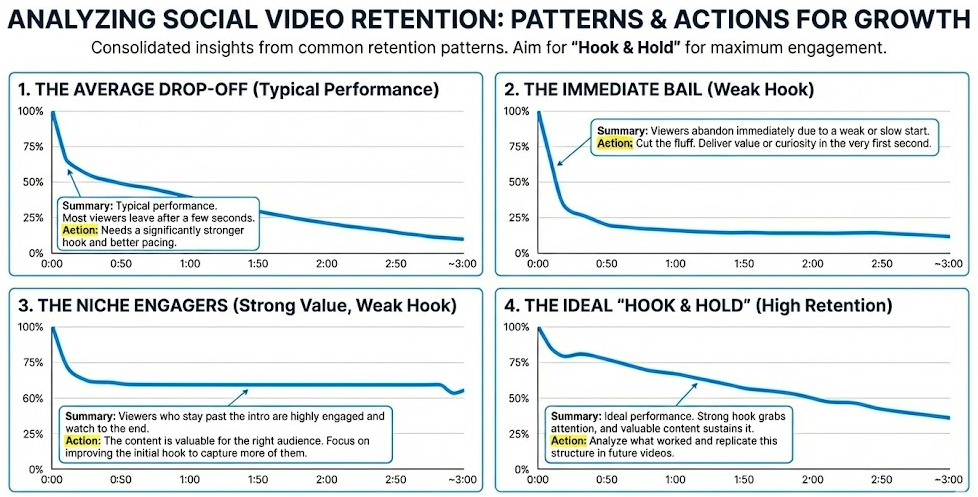
- 📉 1. The Average Drop-Off (Typical):
Most viewers leave after a few seconds. This is "standard," but standard doesn't scale.
The Fix: You need to tighten the pacing and add more visual pattern interrupts every 3-5 seconds. - 🚫 2. The Immediate Bail (Weak Hook):
A vertical drop in the first second. This is a disaster. It means your hook was boring, slow, or felt like a "bait and switch."
The Fix: Cut the fluff. Start with the action or the controversy in the very first frame. - 💎 3. The Niche Engagers (Hidden Gem):
This is the most heartbreaking graph. The people who stayed loved it (flat line), but the hook wasn't broad enough to get the masses in.
The Fix: Your content is gold. Do not change the script. Just swap out the first 3 seconds for something punchier. - 🦄 4. The "Hook & Hold" (The Goal):
A smooth, gradual decline. This is the unicorn. The hook grabbed them, and the value kept them.
The Action: Do not touch this ad. Duplicate it and scale the budget.
💡 The Takeaway
The shape of the line tells you exactly what to fix. Vertical drop? Fix the Hook. Slow bleed? Fix the Value.
Visual Hook Inspiration: a "stich"

⚠️ A Warning: Hook Rate ≠ Profit
It is tempting to obsess over this number, but be careful.
Generally speaking, a consistently good Hook Rate is great news—it lowers your CPMs and trains the algorithm to find more buyers. But a high Hook Rate on a single video does not necessarily mean high returns.
If you use misleading clickbait to get a 60% Hook Rate, viewers will realise it's a "bait and switch" and leave before the Value is delivered. You will pay for thousands of cheap views that never convert.
⚡ Need Ideas?
Struggling to come up with the "Contrarian Snapback" or the right "Context"? We built a tool that does it for you.
Stop guessing. Start measuring.
- Mika
Author